
MCQ C
1. Orthodontic is that specific area of dental practice that has as its responsibility the study and supervision of the growth and development of the ( 1 ) and its related( 2 ) from birth to dental maturity, including all preventive and corrective procedures of dental irregularities requiring the repositioning of teeth by functional or mechanical means to establish normal occlusion and pleasing facial contours (
A. 1 Dentition , 2 nasomaxillary complex
B. 1 Occlusion , 2 mandible
C. 1 Cranium, 2 cranial base
D. 1 Dentition , 2 anatomical structures
2. Orthodontics guides the developing dentition to attain optimum occlusal relations in ( ) harmony with other facial and cranial structures (
A. Physiologic and social
B. Physiologic and esthetic
C. Esthetic and functional
D. Esthetic and social
3. Optimum occlusion must have following features(
A. Balance
B. Stable
C. Normal function
D. All of them
4. Buccinator mechanism consists of ----
A. Buccinator muscle, orbicular oris, superior constrictor muscle.(
B. Buccinator muscle, masster muscle, orbicular oris
C. Buccinator muscle. Medial pterygoid muscle, orbicular oris
D. Buccinator muscle, Lateral pterygoid muscle, orbicular oris. Answer A.
5. Position and form will be influenced by two forces, from outside ( 1. ) Inside ( 2. )(
A, 1. Buccinator and lip 2. Tonsil
B. 1. Lip 2. Tooth size
C. 1. Buccinator and lip 2. Tongue
D 1. Buccinator 2 Adenoid Answer C
6. What will break the balance between tongue and lip/ cheek (
A. Iip function
B. Large tongue
C. Mouth breathing
D. All of them Answer D.
7. Which one will cause an open bite?(
A. Thumb sucking
B. Tongue thrusting
C. Mouth breathing
D. All of them
8. Mouth breathing will cause following findings(
A. Wide maxilla
B. Narrow mandible
C. Long face
D. Counter clockwise rotation
9. Airway obstruction which will induce mouth breathing will be caused by-------(
A. Allergy
B. Large adenoid
C. Nasal septum deviation
D. All of them Answer D
10. What are the causative factors? 1. Micro rhino dysplasia 2. Enlargement of adenoid tissue 3. Allergy 4. Nasal septum deviation 5. Unconscious habit(
A,1,2,
B,12,3,
C.1,2,3,4,,
D. 1,2,3,4,5 Answer D.
11. What are the effects of dental arch and jaws in mouth breathing? 1. Narrow intercanine width in maxilla 2. Lower tongue position 3. Downward and backward rotation of mandible 4. C III molar relationship 5. Short face (
A 1,2
B, 1,2,3,
C. 1,2,3, 4
D all of them
12. In case mouth breathing, what part we should check? 1. Nares 2. Nasal mucosa 3. Nasal septum 4. Adenoid 5. Tonsil(
A. 1,2
B. 1,2,3
C. 1,2,3,4,
D. All of them
13. What are not functions of Stomatognathic function?(
A. Mastication
B. Speech
C. Respiration
D. None of them
14. Growth is ( 1 ) changes and Development is ( 2 ) changes(
A. 1 Morphological 2. Functional
B. 1. Morphological 2. Esthetic
C. 1. Functional 2. Morphological
D. 1. Functional 2. Esthetic
15. Three types of growth at cellular level(
A. Accretionary G, Multiplicative, G, Genital G.
B. Accretionary G, Genital G. General G.
C. Accretionary G. Multiplicative G, Dimensional G
D. Accretionary G, Multiplicative G, Differential G
16. There are two types of growth, interstitial growth and appositional growth. Which one is correct?(
A. Soft tissue can grow interstitially and do multidirectional expansion
B. Bone grow only appositionally. Not interstitially
C. Cartilage can grow interstitially and appositionally.
D. All are correct
17. Dr. Scammon ‘s growth curve shows 1. Differential growth rate in different tissue at different time/ 2. Brain and head will reach 95% of adults size by the age 7-8 /3. Lymphoid tissue exceeds the size of adults by the age of 11-12, reaching 190% of the adults size./4. Reproductive organ grows very slowly in early age, after 14 it grow fast.(
A. 1,2
B. 1,2,3,
C. 1,2,3, 4.
D. All is incorrect.
18. What option is the most popular one for the research of craniofacial growth?(
A. Craniometry
B. Biometry
C. Roentgen cephalometry
D. Vital staining
19. What method of gathering growth date is most precise and valuable data?(
A. Cross sectional data
B. Longitudinal data
C. Semi cross sectional data
D. Semi longitudinal data
20. How can we use the normal growth data? 1. Can Find out the difference between individual and normal data / 2. Can explain the abnormality of patient from Normal growth data /3. Can Find out changes of growth pattern /4. Can Refer to Growth modification /5. Use as the foundation for treatment planning(
A. 1,2
B. 1,2,3,
C.1,2,3,4,
D. 1,2,3,4,5,
21. Head will be ( 1 ) of whole body length at birth, but it will become ( 2 ) at adult(
A. 1. 1/2 , 2. 1/4
B 1. 1/4 2. 1/8
C. 1. 1/6 2. 1/ 10
D. 1. 1/8 2. 1/12
22. Bone has the following characteristics, which one is incorrect?(
A. Appositional growth
B. Interstitial growth
C. Pressure sensitive
D. Tension sensitive
23. Cartilage has the following characteristics, which one is incorrect?(
A . Appositional growth
B. Interstitial growth
C. Pressure tolerant
D. Tension tolerant
24. Endochondral ossification occurs in hyaline cartilage prototype models of the future bone,. Which one is not from endochondral bone formation?(
A. Long bone of limbs
B. Nasal cartilage
C. Cranial base
D. Parietal bone
25. Which one is Intramembranous bone ? 1. Frontal bone 2. Mandible 3. Maxilla 4. Cranial base 5. Basioccipital bone(
A.1.2
B, 1,2,3,
C. 1,2,3,4
D. All of above
26. Which one is incorrect for the characteristics of Intramembranous bone?(
+A. Resorption under pressure
+B. Deposition under tension
+C. Resorption under tension
+D. none
27. Histological differences between long bone and condylar cartilage? Incorrect one(
+A. Long bone has collum like arrange of cell
+B. Long bone has fibrous covering membrane
+ C. Condylar cartilage show radiated cell arrangement
+ D. Condylar cartilage is phylogenetically 2ndary cartilage
28. How many bones are there in skull at birth?(
A. 35
B. 45.
C. 50
D. 55
29. How many bones are there in Skull after completion of ossification?(
A. 12
B. 18
C. 22
D. 25.
30. Basic mechanism of growth movement of cranio-facial bone is caused by (1) and (2)(
A. 1.Drift 2. Displacement
B. 1.Apposition 2. Resorption
C. 1.Primary displacement. 2. 2ndary placement
D. 1.Resorption 2. Enlargement
31. Bone grow by adding new bone tissue on one side of bony cortex that is new bone deposition and taking it away from the other side that is resorption. It produces a direct growth movement of any given area of a bone. We call it______.(
A. Drift
B. Displacement
C. Enlargement
D. Expanding
E.
32. When a bone grows, it has to adapt to a new position and function. So that the bone has to alter itself locally in progressive and continuous manner with growth. Then a bone can increase in size by neither change of its initial shape nor its own functional responsibility. This process is called ________________________(
A. Drift
B. Displacement
C. Development
D. Bone remodeling
33. Growth of Cranial vault is carried out by Sutural and ____________ Growth(
A. Cartilage
B. interstitial
C. Periosteal
D. fun
34. What is the factors to promote the growth of cranial vault?(
A. Gene
B. Muscle force
C. Growth of Brain
D. Growth of cranial base
35. Correct ?(
+A. Hydrocephaly -------Excessive cerebrospinal fluid in the brain case enlarges the cranium.
+B. Brachycephaly--------premature closure of coronal suture
+C. Scaphocephaly-------premature closure of sagittal suture
+D. All of Above
36. Which statement is incorrect for the growth of braincase?(
A. It grows sutural and periosteal deposition
B. It can be altered by external forces such as orthopedic force
C. Growth of Brain control the growth of brain case
D. Early closure of suture is not effect on the brain case.
37.Which one is not in the cranial base?(
A. Spheno-Occipital synchondrosis
B. Spheno-Ethmoidal synchondrosis
C. Inter-sphenoidal synchondrosis
D. none
38. When will Spheno-Occipital synchondrosis stop growth?(
A. At birth
B. 7 years
C. 14-16 years
D 18-20 years
39. What Synchondrosis will disappear at birth?(
A. Spheno-Occipital synchondrosis
B. Spheno-Ethmoidal synchondrosis
C, Inter- Sphenoidal Synchondrosis
D.None
40. Spheno-Occipital Synchondrosis is the most important one in cranial base. Correct one?(
A. Its growth influence on the occlusion
B. Influence the relationship between maxilla and mandible
C. Grow two directions, anteriorly and posteriorly
D. All of above
41. The followings are the relationship between head type and occlusion, the incorrect one is?(
A. Dolichocephaly type ----- Class II
B. Brachycephaly type--------Class III
C. Dolichocephaly type-------large cranial base angle
D. Brachycephaly type -------Large cranial base angle
42. The followings are the growth of cranial base, which one is right? 1. Endochondral bone formation / 2. It can not be controlled by external force / 3. Growth of SO synchondrosis affect on the maxillomandibular relationship / 4. Cranial base angle cannot effect on the position of TMJ / 5. All of above(
A. 1.2
B. 1,2,3
C. 1,2,3,4,
D. 5.
43 What bones does the maxilla articulate with?(
A. Frontal and ethmoid
B. Zygomatic bone
C. Nasal bone
D. All of above
44. The following are the growth of maxilla. Which one is right? 1. Intramembranous bone formation / 2. Bone deposition at the maxillary tuberosity and alveolar process / 3. Sutural growth / 4. Bone resorption at the roof of oral cavity / 5. Bone deposition at the floor of nasal cavity(
A. 1.2.
B. 1,2,3.
C, 1,2,3,4,
D. 1,2,3,4,5.
45 .The following is the characteristics of condylar cartilage. Which one is incorrect?(
A. It does originate from Meckel’s cartilage
B. It emerged Phylogenetically to resist against pressure.
C. It covered by fibrous membrane which originate from periosteum
D. It does not originate in the primary cartilage of the chondrocranium.
46. Which one is incorrect for the definition of term of rotational growth of mandible?(
A. Total rotation------ SN to Mandible core(metallic implant line)
B. Matix rotation-------SN to Mandibular plane
C. Intra matrix rotation ----total rotation minus Matrix rotation
D. Intra matrix rotation-----total rotation plus Matrix rotation
47. There are two patterns of mandibular growth, clockwise and counterclockwise. Pattern. Which one is correct?(
A. Clockwise pattern -------high (Posterior facial height /posterior facial height) ratio
B. Counterclockwise pattern—small number of Bjork Sum
C. Clockwise pattern -----CII skeletal pattern
D. Counterclockwise pattern----small cranial base angle
48.Which one is the most reliable method for evaluation of individual skeletal maturation?(
A. Chronological age
B. Dental age
C. Body height curve
D. Hand wrist X ray(SMI)
49. Appearance of Sesamoid bone in Handwrist Xray means (
A. On set time of pubertal growth
B. Just before Pubertal growth spurt
C. End of pubertal growth
D. None of above
50. What is indicator of completion of growth in Handwrist Xray(
A. MP3
B. Appearance of Sesamoid
C. MP3 Capping stage
D. Radius fusion stage
51.which one is indicator for pubertal growth spurt in handwrist Xray(
A. PP3
B. Appearance of Sesamoid bone
C. MP3 Capping stage
D. MP3 Fusion stage
52. What is an indicator for Class III surgery timing in Handwrist Xray(
A. MP3
B. Appearance of Sesamoid
C. MP3 Capping stage
D. Radius fusion stage
53. Cervical vertebra on the Cephalogram can be used to evaluate individual skeletal maturation without handwrist. What number of Cervical vertebra do we usually use?(
A. C 1,2,3
B. C 2.3.4.
C. C 3.4.5.
D. C,1- 5
54. These are the relationship between amount of developmental space in primary dentition and possibility of crowding in permanent dentition. Which one is incorrect?(
A. No spacing in primary dentition will show crowding in all in permanent dentition
B. Less than 3mm spacing will show crowding in 50% of them
C. 3-6 mm spacing will show crowding in 20 % of them
D. More than 6mm spacing will show little likelihood of crowding
55.Dr. Nolla divided the formation or calcification of permanent teeth into 10 stages. What stage is crown completion?(
A. Stage 4
B. Stage 5
C. Stage 6
D. Stage 7.
56. What stage is 1/3 Root formation?(
A. Stage 4
B. Stage 5
C. Stage 6
D. Stage 7.
57. Which one is not factor regulating and affecting teeth eruption?(
A. Gene
B. Apical lesion
C. Nutrition
D. Dental caries
58. which Eruption sequence is correct?(
A. Mx: 1234567 Mn 1234567
B. Mx 6124537 Mn 6123457
C. Mx: 6124573 Mn 6123475
D. Mx: 6123457 Mn 6124537
59. During eruption, all teeth erupt in the mesial direction even in alveolar bone. This is called as___________________________.(
A. Forward tendency
B. Anterior tilting tendency
C. Mesial drifting tendency
D. Anterior component of force
60. When upper and lower teeth occlude during mastication, due to mesial axial inclination of teeth, chewing forces produce a mesial resultant through the contact points of teeth. The resultant forces is called ______________________.(
A. Mastication force
B. Mesial drifting force
C. Anterior component of force
D. Mesial drifting tendency
61. The reason why arch perimeter in mandibular arch decrease during transitional period. Which one is right? 1.Late mesial shift(Lee way space) / 2.Mesial drifting tendency / 3.Slight interproximal wear / 4.Lingual positioning of the incisors / 5.Originally tipped position of incisors and molars(
A. 1.2.
B. 1.2.3.
C. 1.2.3.4.
D. All of them.
62. The following is changes of arch perimeter during the transitional period. Which is right? 1. Maxillary arch show slight increase in arch perimeter / 2. Mandibular arch show decrease in arch perimeter / 3. Maxillary arch show decrease in arch width / 4. Mandibular arch show increase in arch perimeter(
A. 1
B. 1.2
C.123
D 1234
63. What do we call” Tooth size difference between 4 primary incisors and 4 permanent incisors”?(
A. Leeway Space
B. Primate space
C. Incisors liability
D. Developmental space
64. What do we call the tooth size difference between primary CDE and permanent 345?(
A. Leeway Space
B. Primate space
C. Incisors liability
D. Developmental space
65. The following is dissolving factors of incisors liability. Which is right? 1. Slight increase of arch width / 2. Developmental space / 3. Labial eruption of permanent incisors / 4. Primate space(
A. 1,2
B. 1,2,3
C. All of them
D. None of them
66. How much is Average Leeway space?(
A. Maxilla 0.7-1mm Mandible 2.8mm
B. Maxilla 2-2.5mm Mandible 0.7-1mm
C. Maxilla 0.7-1mm Mandible 0.8-1mm
D. Maxiilla 2-2.5mm Mandible 4-5mm
67. There are 3 terminal plane in primary dentition, distal step, flush terminal plane, mesial step. (
A. Mesial step will go only C II molar relationship
B. Flush terminal plane will not go CIII.
C. Distal step can go only CIII
D. Flush terminal plane will go only CI
68.How do occlusal changes occur from flush terminal (End to end molar) to Class I molar relationship during transitional period.(
A. Early mesial shift and mandibular growth
B. Late mesial shift and mandibular growth
C. Mesial drifting tendency and mandibular growth
D. Anterior component of force and mandibular growth
69. If you want to promote successor permanent tooth, when do we extract predecessor primary tooth?(
A. Nolla’s stage 5 of successors permanent tooth
B. Nolla’s stage 7 of successors permanent tooth
C. Nolla’s stage 9 of successors permanent tooth
D. Nolla’s stage 10 of successors permanent tooth
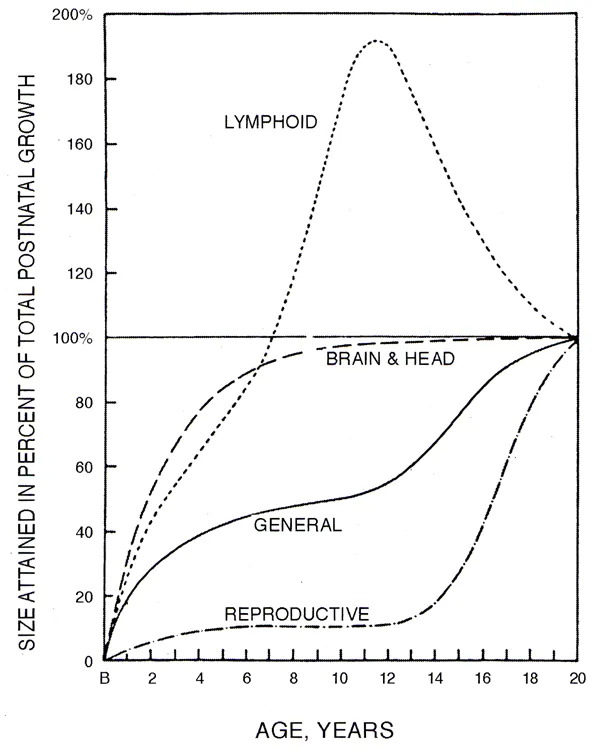
70. This is Dr. Scammon’s growth curve . Which one is correct combination?(
A 1. Lymphoid tissue 2. General body 3. Brain and head 4. Reproductive
B 1. Brain and Head 2. Lymphoid tissue 3. Reproductive 4. General body
C 1. Lymphoid tissue 2. Brain and head 3 .General body 4. Reproductive
D 1. Lymphoid tissue 2. General body 3. Brain and head 4. Reproductive
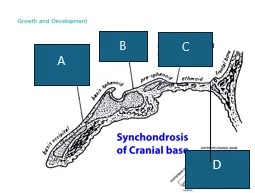
71. This is schematic drawing of cranial base. Which synchondrosis grows until the latest?(
A
B
C
D
72. The MOST stable area to evaluate the craniofacial growth is (
A. Nasal floor
B. Occlusal plane
C. Naso maxillary complex
D. Anterior cranial base
73 The human face is displaced (
A. Downward and forward.
B. forward.
C. downward.
D. Upward and forward
74. At birth, which of the following structures is farthest from the size it will eventually be in adulthood? (
A. Cranium
B. Nasal capsule
C. Middle face
D. Mandible
75. Additional space for the eruption of succeeding maxillary molars is made by (
A. Continuous expansion of the dental arch.
B. Downward and forward displacement of the maxillary complex.
C. Interstitial bone growth.
D. Appositional growth at the maxillary tuberosity.
76. Cartilage can grow by which of the following methods?(
A. Interstitial growth only
B. Appositional growth only
C. Both appositional and interstitial growth
D. Degenerative changes into bony structures
77. At birth, which of the following structures is nearest the size it will eventually attain in adulthood? (
A. Cranium
B. Mandible
C. Clavicle
D. Middle face
78. Arch length space for the eruption of permanent mandibular second and third molars is created by (
A. Apposition of the alveolar process.
B. Apposition at the anterior border of the ramus.
C. Resorption at the anterior border of the ramus.
D. Resorption at the posterior border of the ramus
79. . Cephalometric studies show that, on the average, a. The mandible grows more slowly than the maxilla. b. The maxilla, during growth, is translated in a downward and forward direction. c. Cranial base growth determines mandibular growth. d. Mandibular growth stops after maxillary growth. (
A. (a) and (b)
B. (b) and (c)
C. (b) and (d)
D. (c) and (d)
80. The cranial vault increases rapidly in size the first few years postnatally and completes approximately 90 per cent of its growth by 6 years of age. This is typical of which of the following types of tissues? (
A. Neural
B. Dental
C. Genital
D. Lymphoid
81. Which of the following are sites of cartilaginous growth postnatally? a. Spheno-occipital synchondrosis b. Mandibular condyle c. Frontomaxillary suture d. Nasal septum e. Alveolar process (
A. (a) and (b) only
B. (a), (b) and (d)
C. (b), (c) and (e)
D. (c) and (e) only
82. Interstitial growth is observed at which of the following sites? a. Spheno-occipital synchondrosis b. Maxillary tuberosity c. Mandibular condyle d. Zygomaticomaxillary suture e. Apex of an erupting premolar. (
A. (a) and (b)
B. (a) and (c)
C. (a) and (d)
D. (b) and (d)
83. Cartilage differs from bone in that cartilage can increase in size by (
A. apposition
B. Sutural expansion
C. Interstitial growth
D. Selective resorption
84. Cross-sectional growth studies sample (
A. Different individuals at the same age intervals.
B. The same individuals, but different midsagittal sections.
C. Different individuals and different sagittal sections.
D. The same individuals at different age intervals.
85. The grand design of the human face is the result of two growth processes which interact to produce the final result. What are they? 1. Remodeling 2. Displacement 3. Disarticulation 4. Occlusal equilibration 5. BPRD (
A. 1 and 2
B. 2 and 3
C. 3 and 4
D. 1 and 4
86 The maxilla grows by: (
A. Downward and Forward Displacement.
B. Interstitial enlargement in the area of the tuberosity.
C. Upward and backward endochondral bone formation.
D. All of the above
87. Brachycephalic headforms are associated with Class III malocclusions (relative mandibular prognathia) and Dolichocephalic headforms are associated with Class II malocclusions (relative mandibular retrognathia) . (
A. Both statements are true.
B. The first is true the second false.
C. The second is true the first false.
D. Both statements are false.
88.. Mandibular retrusion tends to be a characteristic of:(
A. The brachycephalic individual.
B. The short nose individual.
C. The male dolichocephalic.
D. Females regardless of headform type
89. . In the primary dentition, a terminal plane occlusion usually turns into… (
A. Class I
B. Class II
C. Class III"
D. Class II and III.
90 What happens in lower arch length from deciduous to permanent dentition when measuring from the mesial of the first molars? (
A. Increases a lot
B. Increases a little
C. Decreases a lot
D. Decreases a little
91. Where are the primate spaces? (
A. Mesial to maxillary canine and distal to mandibular canine
B. Distal to maxillary and mandibular lateral incisors
C. Distal to maxillary and mandibular canines
D. Mesial to maxillary lateral incisors and distal to mandibular canine" a. Mesial to maxillary canine and distal to mandibular canine
92. Which bone is purely intramembranous? (
A. Parietal and frontal
B. ethmoid
C. temporal"
D. Nasal
93. How many bones are in the craniofacial complex of adults? (
A. 8
B. 14
C. 20
D. 22"
94.How many bones are in craniofacial at birth?(
A.12
B.20
C.22
D.45
95 The palate grows down by (
A. Apposition on the roof of oral cavity
B. Sutural growth
C. All of the above
D. None of the above
96. . The human face is displaced(
A. Downward and forward.
B. forward.
C. downward.
D. upward.
97. How does growth of the cranial base generally relate in time to growth of the jaws? (
A. Precedes
B. Follows
C. Accompanies
D. Initially follows then accompanies
98The "V" principle of growth is illustrated by the (
A. Nasal septum.
B. Mandibular condyle.
C. Mandibular symphysis.
D. spheno-occipital synchondrosis
99. The greatest period of cranial growth occurs between (
A. Birth and 5 years of age.
B. 6 and 8 years of age.
C. 10 and 12 years of age.
D. 14 and 16 years of age.
100. What is the chief factor in the formation of the alveolar process? (
A. Eruption of teeth
B. Normal process of growth
C. Lengthening of the condyle
D. Overall growth of the bodies of the maxilla and the mandible
101. After age 6, the greatest increase in size of the mandible occurs (
A. At the symphysis.
B. Between the canines.
C. Along the lower border.
D. Distal to the first molars.
102. In determining a patient's skeletal growth pattern, the most important factor is A. diet. (
B. habits.
C. heredity.
D. Dental occlusion.
103. Cartilage tissue is pressure tolerant and able to provide flexible support because it is avascular and contains an intracellular matrix of proteoglycans. (
A. The first statement is True, the second statement is true and they are related.
B. The first statement is True, the second statement is true and they are NOT related.
C. The first statement is True, the second statement is False
D. The first statement is False, the second statement is trueAnswer A.
104 Which of the following statements correctly describe bone growth: 1. There is a general uniform deposition of new bone on all periosteal surfaces. 2. There is a general uniform resorption of bone on all endosteal surfaces. 3. The endosteal surface may contribute significantly to new bone formation. 4. Interstitial growth of bone is necessary to change the morphology of the fetal face to the adult face. 5. Displacement of bones is necessary to change the fetal face to the adult face.(
A. 1 and 2
B. 1, 2 and 3
C. 3, 4 and 5
D. 3 and 5
105. Cortical drift occurs by a combination of periosteal deposition and endosteal resorption because deposition and resorption always occur together in equal and opposite amounts.(
A. The first statement is true, the second statement is true and they are related.
B. The first statement is true, the second statement is true and they are NOT related.
C. The first statement is false, the second statement is true.
D. The first statement is true, the second statement is false
106. Growth (remodeling and displacement) occurring in palatine bones results in relative changes in the position of the maxillae. This is an example of: (
A. Secondary displacement.
B. Primary displacement.
C. Cortical drift.
D. The "V" principle of growth.
107. The midface is suspended from: (
A. The cranial base.
B. The mandible.
C. The cerebellum.
D. The spinal cord.
{"name":"MCQ C", "url":"https://www.supersurvey.com/QPREVIEW","txt":"1. Orthodontic is that specific area of dental practice that has as its responsibility the study and supervision of the growth and development of the ( 1 ) and its related( 2 ) from birth to dental maturity, including all preventive and corrective procedures of dental irregularities requiring the repositioning of teeth by functional or mechanical means to establish normal occlusion and pleasing facial contours (, 2. Orthodontics guides the developing dentition to attain optimum occlusal relations in ( ) harmony with other facial and cranial structures (, 3. Optimum occlusion must have following features(","img":"https://cloud.supersurvey.com/uploads/108/5256494-aaaaa.png"}