
Marketing Survey Templates
13 ready-to-run surveys for pricing, market research, concept tests, segmentation and buying intent. Every template opens as a live survey you can read before you field it.
- 13 templates
- 4 to 18 questions each
- 167 questions in total
- Free, no account needed
Marketing surveys, grouped by the decision each one settles: what a market will pay, whether a concept has a buyer, which segment to build for, and what people actually bought last time. Every card opens the real survey, so you can read the full question set and the answer scales without an account or an email address. Open any of these in the SuperSurvey survey maker to swap in your own product names and price points before you field it. If you want the wider library first, browse every survey template.
Which Marketing Survey Should You Run?
Start from the decision, not the survey name. Question counts and completion times are measured from the templates themselves, and every one opens as a live survey you can read first.
| You need to decide | Survey type | When to run it | Length | Mode | Template |
|---|---|---|---|---|---|
| What price the market will actually bear | Willingness to pay | Before you publish a price | 4 q, 2 min | Anonymous | Willingness to Pay Survey |
| Whether your current price still reads as fair | Price evaluation | At renewal, or after a price change | 12 q, 3 min | Confidential | Price Evaluation Survey |
| Whether what you shipped fits the market | Product market research | 30 to 90 days after launch | 13 q, 4 min | Confidential | Market Research Survey |
| Whether the store experience matches the brand | Mystery shop audit | Quarterly, per location | 14 q, 4 min | Identified | Mystery Shopping Form |
| How much of category spend you already own | Share of wallet | Quarterly | 12 q, 3 min | Confidential | Share of Wallet Survey |
| Who is close to buying, and what is blocking them | Buying intent | When a purchase in the next 3 months is realistic | 14 q, 4 min | Anonymous | Purchase Intent Survey |
| Whether a recipe or reformulation held up, blind and then with the label on | Taste test | Before a recipe change ships | 14 q, 3 min per sample | Anonymous | Taste Test Survey |
Market Research Survey Templates
One template, for the stage before you build. The Market Research Survey asks whether the problem exists, who has it, what they use today and what they paid last time, so you can size the gap before you spend on a fix.
Pricing and Willingness to Pay Surveys
Pick by how much price history you have. With no price yet, start with the willingness to pay survey template, which asks people to name the numbers rather than react to yours. With a price already live, Price Evaluation asks whether it reads as fair next to the options buyers actually compared. The Pricing Survey sits between them and tests tiers and bundles, not a single number.
Brand, Naming and Concept Testing Surveys
The Brand Name Survey tests the words before you commit budget and trademark fees to them. Before there is a name to test, the concept testing questions put one idea in front of each person and keep the alternatives out of sight, because showing two together changes which one wins. Once the name is live, the brand awareness survey asks people who may never have heard of you what they can name without being shown a list. Mystery Shopping tests the other half: whether the brand a customer meets at the counter matches the one you wrote down. When you need your brand and one named rival scored on the same six attributes by the same people, use the brand perception survey. For feedback on how a product behaves rather than how it is named, the product UX survey templates are the better fit.
Market Segmentation and Persona Surveys
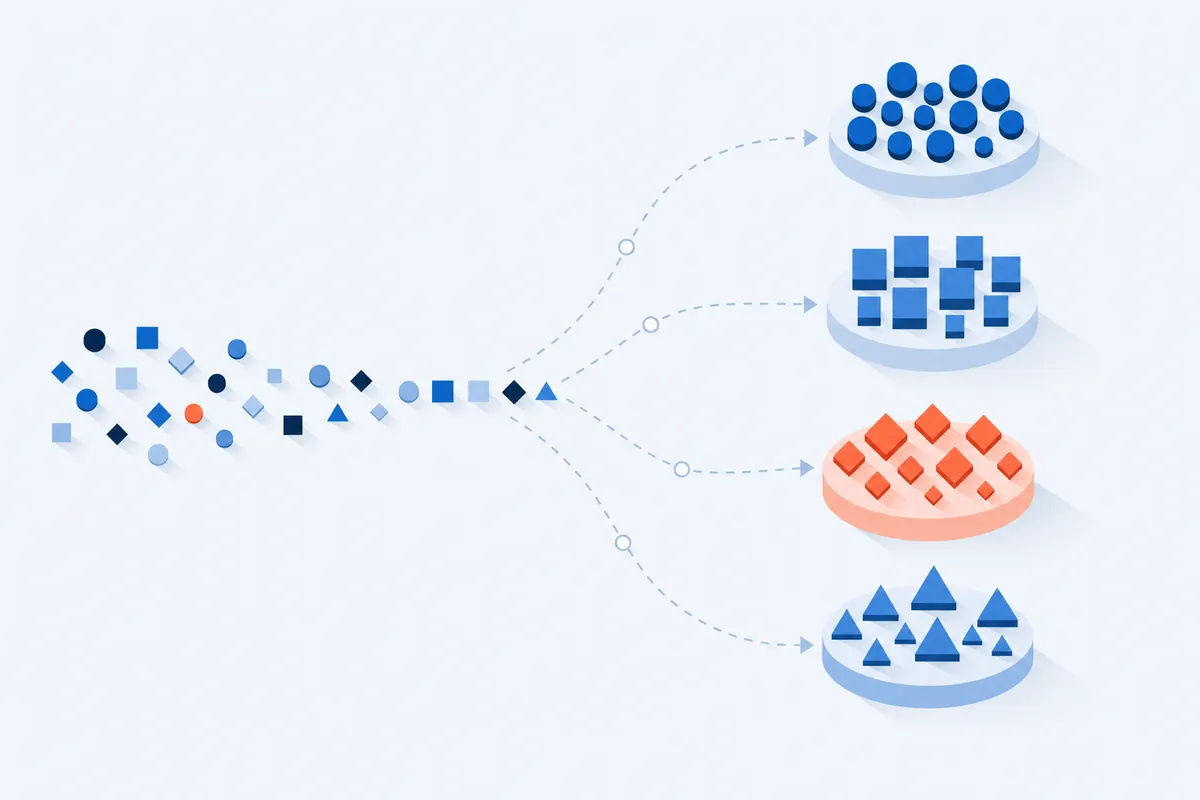
This one splits an audience by money rather than by age or job title. Share of Wallet groups customers by where their category spend already goes, so you can see which segment you are leaking to and which you own.
Buying Intent and Purchase Behavior Surveys
One survey now looks both ways. The Purchase Intent Survey starts with what someone bought last time, which is the steadier signal, then asks whether they will buy one named product in the next three months and what is blocking them. This page stops at the sale; for what happens after it, see the customer service survey templates.
Marketing Survey Questions You Can Copy
Every question below is lifted from one of the templates above, so the wording and the answer scales are already paired. Copy what you need into your own tool, or open the template to get the full set with the scales attached. Nothing here is behind a sign up form.
Price evaluation questions
- "For what I get, the price is worth paying."
- "How would you describe our price to somebody who asked you about it?"
- "I understood exactly what I would be charged before I decided."
- "Compared with the other options available to you, our price is:"
- "If the price went up, what would you most likely do?"
- "What would make you say the price was too high?"
From the Price Evaluation Survey (12 questions, 3 min). No question names a figure: it judges a price people already pay. For the threshold questions that find a price you do not have yet, use the Willingness to Pay Survey.
Market research questions about the problem
- "Which of these describes you best when it comes to [CATEGORY]?"
- "When did you last buy or use something in [CATEGORY]?"
- "Which of these did you pay for in the last 12 months to deal with [PROBLEM]?"
- "Where do you look first when you need something in [CATEGORY]?"
- "Roughly what did you pay the last time you bought something in [CATEGORY]?"
- "It would be easy for me to switch away from what I use now."
From the Market Research Survey (13 questions, 4 min). Replace [CATEGORY] and [PROBLEM] with your own words before you send it, and delete any block you do not need.
Buying intent survey questions
- "When did you last buy a product like this one?"
- "What mattered most when you chose the last one?"
- "How likely are you to buy this product in the next 3 months?"
- "If you do buy something like this, when is that most likely to be?"
- "Have you set aside money for this purchase?"
- "Who else has a say in whether you buy it?"
- "What is the main thing holding you back?"
From the Purchase Intent Survey (14 questions, 4 min). Put the product name in place of "this product" before you send it. Read the answers as a ranking of who to talk to next, not as a sales forecast.[1]
Brand share and competitor questions
- "Roughly how much did you spend in this category over the last 3 months, with every brand or store?"
- "How many different brands or stores did you buy from in this category over the last 3 months?"
- "Roughly what share of that spending went to this brand?"
- "Which other brand or store gets the most of the rest?"
- "Why do you buy some of this category somewhere else?"
- "What would bring more of your spending in this category to this brand?"
From the Share of Wallet Survey (12 questions, 3 min). Name one category and keep the three-month window, so every answer is about the same spend.
How Many Responses Do You Need?
The honest answer is that it depends on how finely you plan to slice the results. Here is the arithmetic, and the part of the error the arithmetic misses.
The arithmetic first
- At 95% confidence the sampling error on a percentage is about 1.96 times the square root of p times 1 minus p, divided by your number of completes. The 1.96 is the z score for 95% confidence.[5]
- The worst case is p at 50%, so every figure below is the widest the error can be for that sample size.
- That is where the famous 384 comes from. For a market of 500,000 people, 95% confidence and a 5 point margin of error, the formula returns 384 completes.[5] Most teams round it to 400.
- The error shrinks with the square root of the sample. Four times the responses halves the error, which is why the curve flattens fast.
- Population size barely matters once your market is larger than about 20,000 people. Sampling 400 of a million is almost as precise as sampling 400 of 20,000.
Match the sample to the read you plan to do
| What you want to read | Completes you need | Widest sampling error |
|---|---|---|
| One overall number, directional only | 100 | plus or minus 9.8 points |
| One overall number you will show a stakeholder | 400 | plus or minus 4.9 points |
| Two segments you want to compare | 400 each, 800 total | plus or minus 4.9 points per segment |
| Four segments you want to compare | 200 each, 800 total | plus or minus 6.9 points per segment |
| Quarter on quarter tracking | 400 per wave | plus or minus 4.9 points per wave |
What these numbers do not cover
- Stated intent is not a forecast. Across the research on intentions and behavior, people follow through roughly half the time, and a medium to large shift in intention produces only a small to medium shift in what people actually do.[1] Rank your respondents by intent, then validate with a real offer.[2]
- Length costs you completes. Analysis of roughly 100,000 surveys found drop off climbing sharply past 7 to 8 minutes, and answer time falling from about 30 seconds per question early on to about 19 seconds late in a long survey.[6] Every template on this page finishes inside 7 minutes.
- Order shapes answers. Ask unaided recall before you show any brand list, and put price questions after the concept description, never before it.[8]
Marketing Survey FAQ
What is a marketing survey?
A marketing survey is a short questionnaire that tests a marketing decision with real buyers before you commit money to it: what to charge, what to call it, who to aim at, and whether anyone wants it. It is the same craft as market research, just scoped to one decision at a time. The chooser table above maps seven common decisions to the template that settles each one.
What is the difference between a marketing survey and a market research survey?
In practice, none worth arguing about. Market research is the wider label, covering category studies, segmentation and concept work. A marketing survey usually means one focused study inside that: a price test, a name test, a buying intent check. The templates here cover both, so pick by the decision you face rather than the label.
What questions should a marketing survey include?
Four blocks, in this order: a screener that confirms the person belongs in your market, a few questions about the problem or category as it exists today, the thing you are testing (a price, a name, a concept), and one open question asking what would stop them. Keep it under ten questions. The question bank has copy ready wording from each template.
How many responses do I need for a market research survey?
100 completes give you a directional read with roughly 10 points of error. 400 gets you under 5 points, which is where most teams stop. Beyond that you are paying for precision you will not act on. If you plan to compare segments, each segment needs its own sample: four groups you want to read separately means about 800 completes in total. The sample size section shows the whole curve.
How do I ask about price without biasing the answer?
Describe what people are buying before you mention any number, and describe it the same way for everyone. Then either ask them to name their own thresholds, which is the Price Sensitivity Meter approach,[3] or show one fixed price and ask a plain yes or no, which is the Gabor and Granger approach.[4] Showing your preferred price first anchors everything that follows.
Should I use the Price Sensitivity Meter or the Gabor and Granger method?
Use the Price Sensitivity Meter when you have no price yet and want a plausible range: it asks four threshold questions and produces a band.[3] Use Gabor and Granger when you have candidate prices and want a demand curve: each person sees one price and says buy or not buy.[4] The Willingness to Pay Survey includes both, so you can run one and keep the other in reserve.
Can I use purchase intent to forecast sales?
Not directly. People follow through on their intentions about half the time, and even a large change in stated intention moves actual behavior much less.[1] Intent is useful as a ranking, not a number: it tells you which segment to approach first and which objection to answer. Confirm the number with a real offer, a pre order or a live price test.
How do I run a market segmentation survey?
Decide the cuts before you field, not after. Pick two or three ways of splitting people that would actually change what you do, size each group to at least 200 completes, and set quotas so one group cannot dominate. Segment on behavior and situation where you can: the Marketing Survey Templates groups people by what sent them looking, which usually separates buyers better than demographics do.
Should a marketing survey be anonymous?
It depends on what you will do next. Keep pricing, brand share and competitor questions anonymous, because people shade those answers when their name is attached. Keep buying intent and research recruitment identified, because following up is the entire point. Say which one you are doing before people answer, and keep the promise. The mode column in the chooser table gives a starting point per template.
How long should a marketing survey be?
Under seven minutes. Drop off rises sharply after that mark, and quality fades before completion does: in a study of roughly 100,000 surveys, people spent about 30 seconds on early questions and about 19 seconds on late ones.[6] Every template on this page is between 4 and 18 questions and finishes in 2 to 5 minutes.
Where should I recruit respondents for a market research survey?
Your own list is cheapest and most biased, since it only contains people who already found you. A panel reaches non customers but attracts practised respondents, so screen hard and add a trap question. Intercepts on your site catch people mid decision, which suits buying intent work. Whatever you use, record where the sample came from and report it beside the result.
Are these marketing survey templates really free?
Yes. Every card opens the real survey with its full question set and answer scales, with no account, no email wall and no trial. You can read it, copy the questions into your own tool, or open it in SuperSurvey and edit it. Nothing on this page is gated.
Methods and Sources
How these templates are built
Question counts and completion times are measured from the templates themselves, not estimated. Items use plain wording, one idea per question, and a screener before anything that could teach the respondent what you want to hear. Pricing questions follow the two established stated preference methods rather than a house style: threshold questions from the Price Sensitivity Meter[3] and fixed price buy or not buy questions from Gabor and Granger.[4] Our process and contributors are on the Authors page.
Why some well known instruments are not reproduced here
Some widely used research instruments are licensed rather than public, so you will not find them reproduced here. Gallup's Q12 items are copyrighted and cannot be administered outside a participating company without permission, and the Utrecht Work Engagement Scale is free for academic use only. Net Promoter, NPS and Net Promoter Score are registered marks, and commercial use of the marks carries licensing conditions, so we describe the recommend question factually rather than branding a template with them. We write our own items instead.
Limits
The sampling figures on this page are worst case sampling error for a simple random sample, computed from the standard formula.[5] They do not measure who your sample missed, who abandoned partway, or how much your question wording nudged the answer, and those are usually larger.[7] Treat stated pricing and intent as ranges to validate, never as forecasts.[1] Where a study reaches the public, the ICC and ESOMAR code sets out what you owe respondents about how their data will be used.[10]
Disclosure
SuperSurvey is our own survey builder. Every template on this page opens as a live preview you can read without creating an account, nothing here is gated behind an email address, and nothing on this page is for sale.
References
- Sheeran, P. & Webb, T.L. "The Intention-Behavior Gap." Social and Personality Psychology Compass 10, no. 9 (2016): 503-518. Concludes that intentions translate into action roughly half the time, and that a medium to large change in intention produces only a small to medium change in behavior. doi:10.1111/spc3.12265
- Morwitz, V.G., Steckel, J.H. & Gupta, A. "When do purchase intentions predict sales?" International Journal of Forecasting 23, no. 3 (2007): 347-364. doi:10.1016/j.ijforecast.2007.05.015
- Kloss, D. & Kunter, M. "The Van Westendorp Price-Sensitivity Meter as a Direct Measure of Willingness-to-Pay." European Journal of Management 16, no. 2 (2016): 45-54. doi:10.18374/EJM-16-2.4
- Gabor, A. & Granger, C.W.J. "Price as an Indicator of Quality: Report on an Enquiry." Economica 33, no. 129 (1966): 43-70. The origin of the fixed price buy or do not buy test. doi:10.2307/2552272
- SurveyMonkey. "Sample Size Calculator: What It Is and How To Use It." Publishes the z score table used here (1.96 at 95% confidence) and the worked example giving 384 completes for a 5 point margin of error. surveymonkey.com
- SurveyMonkey Research. "How much time are respondents willing to spend on your survey?" Analysis of roughly 100,000 surveys. surveymonkey.com
- Pew Research Center. "Public Opinion Polling Basics." On why the reported margin of error does not capture every source of error in a survey. pewresearch.org
- Pew Research Center. "Writing Survey Questions." On question wording, question order and acquiescence bias. pewresearch.org
- Groves, R.M. & Peytcheva, E. "The Impact of Nonresponse Rates on Nonresponse Bias: A Meta-Analysis." Public Opinion Quarterly 72, no. 2 (2008): 167-189. Finds that the response rate is a weak predictor of how biased a survey actually is. doi:10.1093/poq/nfn011
- ESOMAR. ICC/ESOMAR International Code on Market, Opinion and Social Research and Data Analytics. esomar.org
Browse Other Template Categories
That is every live marketing survey template we have. Back to top.